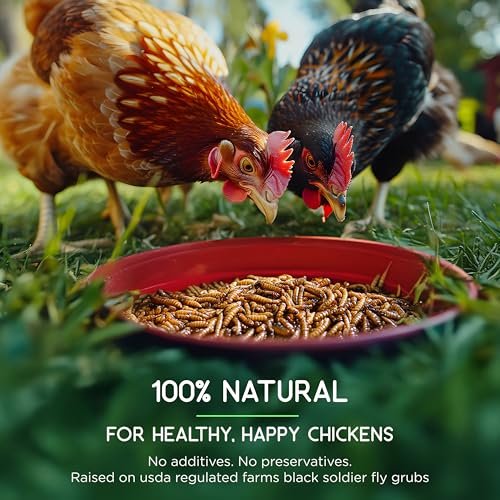
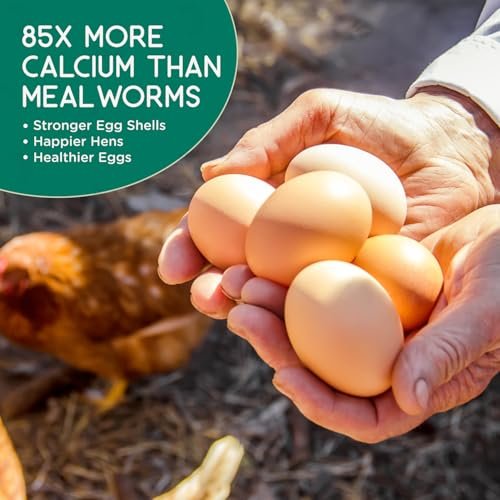
Black Soldier Fly Grubs by FLYGRUBS are dried black soldier fly larvae (BSFL) that deliver 36–42% protein and 85x more calcium than dried mealworms — with a calcium-to-phosphorus ratio that makes every milligram usable rather than just present. The resealable, shelf-stable packaging works year-round with no special storage: no freezer, no fridge, no live insects to manage. One bag covers chickens, laying hens, ducks, turkeys, quail, and most wild birds including bluebirds and wrens. Over 8,025 verified buyers have rated FLYGRUBS 4.8 out of 5 stars — check current sizing and availability on Amazon.
FLYGRUBS contain 2–5% calcium per gram alongside the right phosphorus ratio — so that calcium is actually absorbed, not just present on a label.
Feathers are approximately 90% protein — FLYGRUBS' amino acid profile, including lysine, gives your flock a measurable nutritional input when regrowth demand is highest.
100% dried black soldier fly larvae — no preservatives, no artificial flavors, nothing added — shelf-stable in any season and stored anywhere from kitchen cabinet to barn.
Works for laying hens, ducks, turkeys, quail, bluebirds, robins, and wrens — rehydrate in warm water 15–30 minutes for picky insectivores like bluebirds.
FLYGRUBS comes in three weight options — 5 lb, 10 lb, and 20 lb — with the same nutritional profile across every bag: 85x more calcium than mealworms, 36–42% protein, and zero additives. The right size depends on how many birds you're feeding and how often you want to reorder.
The 5 lb is FLYGRUBS' most popular SKU — rated 4.8 out of 5 stars across 8,025 reviews. It ships in a carton with a resealable inner bag that keeps grubs whole and fresh. The right first purchase for a keeper with 4–15 hens who wants to try BSFL before committing to bulk quantities.
The carton-plus-resealable-bag packaging protects grub integrity better than a standalone bag — a practical advantage if you're storing in a garage or barn where bags get knocked around.
See on Amazon
The 10 lb bag is the best per-ounce value in the lineup for established buyers who've confirmed their flock accepts BSFL. Non-GMO, AAFCO-recognized feed ingredient, with the calcium-to-phosphorus ratio explicitly called out — meaning the calcium advantage isn't just a number, it's bioavailable. Same 4.8-star rating as the 5 lb.
Best for medium-to-large flock keepers who are past the trial phase and want fewer reorder cycles — the durable resealable bag holds up well in barn and shed storage.
See on Amazon
The 20 lb is FLYGRUBS' largest SKU, positioned specifically as a molting supplement alongside its bulk-feed role. Same nutritional profile — 85x more calcium, 36–42% protein, 25–30% healthy fat, plus phosphorus, lysine, and fiber called out in the product overview. This is a newer listing with only 4 reviews at 3.8 stars; check current Amazon ratings before purchasing at this quantity.
The right choice for homesteaders running multiple species or large flocks who go through 5–10 lbs quickly — but given the limited review history, check current Amazon feedback before buying at this scale.
See on AmazonDried mealworms have been the default chicken treat for decades. The case for switching to black soldier fly larvae isn't about trend-chasing — it comes down to four measurable differences that matter to a laying hen's actual health.
Mealworms contain roughly 0.05–0.1% calcium per gram. FLYGRUBS dried BSFL contain 2–5% calcium per gram — which is where the 85x figure comes from. That's not a rounding difference or a marketing stretch. It's a structural difference in what these two insects accumulate during their larval stage.
Here's the part most product listings leave out: calcium absorption requires phosphorus to be present at the right ratio. BSFL contain both, in a ratio that makes the calcium bioavailable. Mealworms contain plenty of phosphorus — but almost no calcium. So when you feed mealworms, you're actually creating a phosphorus surplus without the calcium to balance it, which can actively interfere with calcium absorption from other sources in the diet. That's not a knock on mealworms as an occasional treat. It's a real reason to consider what the treat is actually doing nutritionally.
Dried mealworms run roughly 48–53% protein by dry weight — higher than FLYGRUBS' 36–42%. So mealworms win on raw protein percentage. But protein quality isn't just a quantity number. BSFL contain a complete amino acid profile including lysine, an essential amino acid laying hens can't synthesize themselves. Mealworms are lower in lysine. For a laying hen during molt — when feather regrowth demands spike and feathers are approximately 90% protein — the amino acid completeness matters as much as the total protein number.
This one doesn't show up on nutrition labels, but it matters to a lot of buyers: the overwhelming majority of dried mealworms sold in the US are imported, primarily from China. Import regulations classify them as wild bird food, not livestock feed — which creates a gray area for keepers whose hens produce eggs their family eats. There's also a documented disease-transmission concern related to imported insect feed that has led to regulatory bans in parts of Europe. FLYGRUBS are produced at FDA-filed, US-assessed facilities, which sidesteps the import question entirely.
Both dried mealworms and dried BSFL are shelf-stable without refrigeration, so this category is roughly a draw. One practical edge for FLYGRUBS: the resealable bag and (in the 5 lb version) outer carton packaging keeps the grubs intact longer than the loose bag formats many mealworm products use. Whole grubs stay fresher and are more appealing to birds than grub dust. Buyers who store treats in barns or sheds — where bags get knocked around — notice the difference.
| Comparison Point | FLYGRUBS BSFL | Typical Dried Mealworms |
|---|---|---|
| Calcium content | 2–5% per gram | ~0.05–0.1% per gram |
| Calcium-to-phosphorus ratio | Balanced — calcium immediately bioavailable | Phosphorus-heavy — calcium absorption limited |
| Protein (dry weight) | 36–42% | ~48–53% |
| Lysine (essential amino acid) | Present in complete amino acid profile | Lower lysine content |
| Lauric acid | Present — natural antimicrobial properties | Not present |
| Sourcing | US-raised, FDA-filed facilities | Majority imported (primarily China) |
| Regulatory classification | AAFCO-recognized livestock feed ingredient | Often classified as wild bird food only |
| Refrigeration required | No | No |
The honest summary: mealworms aren't harmful, and a flock that's been eating them for years isn't in danger. But if you're giving treats specifically to support eggshell quality and feather health — which most keepers are — the nutritional case for BSFL is straightforward. FLYGRUBS don't just match mealworms on the metrics that count; they're structurally different in the ways that matter most for a laying hen.
FLYGRUBS have 8,025 reviews at 4.8 stars — that's a real signal. But the reviews also surface three recurring scenarios that are worth knowing about before your bag arrives. None of them are deal-breakers, but walking in without context leads to frustration that shows up in one-star reviews.
Chickens are neophobic. That's not a personality quirk — it's a documented behavioral trait in poultry. They're wired to be suspicious of new foods, and some hens will walk right past a pile of FLYGRUBS for several days before deciding they're safe to eat. This doesn't mean your flock hates them. It means your flock is behaving like chickens.
The community-tested fix: mix a small amount of FLYGRUBS into whatever treat your birds already go crazy for — scratch grain, cracked corn, dried cranberries. Let them pick through it. After two or three days of finding FLYGRUBS alongside something familiar, most flocks make the connection. There are Reddit threads where keepers describe their birds ignoring BSFL for an entire week and then suddenly sprinting across the yard for them. Patience is the actual fix here, not a different product.
One honest data point: a small percentage of flocks genuinely don't take to dried BSFL regardless of the introduction method. It's uncommon — the review record suggests it's well under 5% of buyers — but it happens. If yours is one of those flocks after two weeks of patient introduction, the 5 lb starting point limits the waste.
The 20 lb SKU is literally titled a "molting supplement," and FLYGRUBS' protein content does support feather regrowth. Feathers are approximately 90% protein, and extra protein during molt is real nutritional support — not a marketing claim. But molt duration is driven by photoperiod (day length), hen age, breed, and overall health status. No treat shortens a 10-week molt to 6 weeks.
What FLYGRUBS realistically do during molt: they contribute high-quality protein and lysine to the daily diet, which supports the regrowth process. Buyers who add them during molt and see faster regrowth are likely also feeding a complete layer feed and managing their flock well. The grubs aren't doing it alone. Keepers who buy FLYGRUBS expecting a molt cure and then watch their hens take 12 weeks anyway will be disappointed — not because the product failed, but because the expectation was wrong from the start.
A recurring theme in the review record: some buyers receive bags with a high ratio of broken grubs and powder rather than intact larvae. This is more commonly reported in the standalone bag format (10 lb) than in the carton-plus-bag format (5 lb). Whole grubs are more palatable to birds than grub fragments — and the texture difference matters especially for wild birds. If you receive a bag with significant breakage, FLYGRUBS' Amazon listing falls under standard Amazon return and replacement policies. The issue is real enough to mention; it's also not the typical experience given the overall rating, but it's worth noting before you open the bag in the barn and can't easily document it for a return.
Robins, wrens, mockingbirds, catbirds, and nuthatches typically accept FLYGRUBS readily — the dried texture isn't a barrier for most insectivores. Bluebirds are a genuinely different story. There's documented community experience — from BWD Magazine to backyard birding forums — of bluebirds flatly ignoring dried BSFL that they'd eat without hesitation if rehydrated. If you're feeding specifically for bluebirds and skip the rehydration step, you may conclude the product doesn't work when the product is actually fine and the preparation method is the variable. The rehydration guide in the Wild Bird Feeding section below covers this in full.
Wild bird use is where FLYGRUBS generates the most confusion — and the most preventable frustration. Most of it comes down to one variable: whether you rehydrate the grubs before offering them. Get that right for the right species and acceptance rates go up dramatically.
Most insectivorous wild birds will accept dried FLYGRUBS directly from a feeder. The species that tend to adopt them quickest:
For these species, offer FLYGRUBS in a shallow platform feeder or scatter them near a brush pile or log. Ground presentation works especially well for robins and mockingbirds, which forage naturally at low heights. Start with a small amount — roughly a tablespoon — and observe. Most of these birds won't need more than a day or two to recognize the food.
Bluebirds are notoriously texture-sensitive. In the wild, they eat live insects almost exclusively — a dried, shrunken grub looks and feels nothing like what they're used to catching mid-flight or pulling from the soil. The dried version isn't nutritionally inferior, but it's perceptually wrong. This is the documented reason bluebird feeders report rejection: not flavor, not smell, but texture and movement cues.
Rehydration changes the equation. A grub soaked for 20–30 minutes in warm water plumps back up to something closer to live-larva texture and weight. Multiple birding community reports — including accounts in bluebird-specific forums — confirm that birds who refused dried FLYGRUBS repeatedly accepted the rehydrated version on the first or second offering. The nutritional profile is unchanged by soaking.
The process is straightforward:
Use a dedicated bluebird feeder with a small entrance hole if starlings or house sparrows are competing at your platform feeders. Bluebirds are easily displaced by more aggressive species, and a specialized feeder keeps the FLYGRUBS available to the birds you're actually targeting.
| Species | Rehydration Needed? | Best Feeder Type | Placement |
|---|---|---|---|
| Bluebirds | Strongly recommended | Covered bluebird feeder (small entrance) | Open area, 4–5 ft high, near perch |
| Robins | Optional — often unnecessary | Open platform or ground scatter | Low to ground near lawn edge |
| Wrens | Not needed | Platform feeder or small dish | Near brush or shrubs |
| Mockingbirds | Not needed | Open platform or ground scatter | Open ground or low platform |
| Nuthatches | Not needed | Platform feeder or clinging-style | Near tree trunk, 5–8 ft high |
| Chickadees | Not needed | Small platform or dish feeder | Near cover, any height |
One note on seasonal timing: wild birds are most receptive to high-protein food sources during nesting season (spring and early summer), when they're feeding nestlings that need concentrated protein to grow. Offering FLYGRUBS during this window builds the strongest feeding habit. Birds that discover the feeder in April and May tend to return to it reliably through fall.
The most common misconception circulating on BackyardChickens.com is that you can scatter FLYGRUBS freely throughout the day. You can't — or rather, you shouldn't. The 90/10 rule exists for a reason, and FLYGRUBS are a supplement treat, not a feed replacement. Here's what the actual numbers look like.
Ninety percent of a laying hen's daily diet should come from a complete layer feed. Treats — all treats combined, including FLYGRUBS — should make up no more than 10%. FLYGRUBS themselves recommend 5–10% of the diet as BSFL, which in practical terms works out to roughly 0.5–1 oz per hen per day. For a flock of 10 hens, that's 5–10 oz total — about one to two small handfuls scattered across the yard or added to a dish.
The reason this matters isn't arbitrary caution. A laying hen eating 15–20% of her calories from treats instead of layer feed is getting less of the complete mineral and vitamin profile she needs for consistent egg production. More FLYGRUBS doesn't mean better calcium — it means less of everything else. The 5–10% window is the range where you get the nutritional benefit without displacing the diet that sustains it.
| Species | Daily Treat Allowance (per bird) | FLYGRUBS Amount (5-10% of diet) | Notes |
|---|---|---|---|
| Laying hens | ~10% of daily intake | 0.5–1 oz per hen | Reduce slightly for heavy producers |
| Ducks | ~10% of daily intake | 0.75–1.5 oz per duck | Ducks eat more aggressively; monitor intake |
| Turkeys | ~10% of daily intake | 1–2 oz per turkey | Scale up proportionally to body size |
| Quail | ~10% of daily intake | Small pinch per bird | Quail are small — even a few grubs matters |
| Wild birds | Ad-lib (feeder-based) | 1–2 tbsp per feeder session | Refresh daily; rehydrate for picky species |
Molt is the one context where bumping FLYGRUBS slightly above the standard treat threshold is widely practiced in the keeper community. Feathers are approximately 90% protein, and a hen in full molt is rebuilding thousands of them simultaneously while also managing the stress of depleted energy reserves. Many keepers increase to two or three small handfuls per day during active molt — roughly doubling the standard amount.
This isn't unlimited feeding. It's a temporary increase in protein support during a period of elevated demand. Once pin feathers are coming in and the flock looks like it's past the worst of molt, return to the standard 5–10% rate. FLYGRUBS work alongside a complete layer feed during this window — not in place of it. Protein alone doesn't end molt. Photoperiod does. But adequate protein during the process supports faster and fuller regrowth.
At 0.5 oz per hen per day, a 5 lb bag (80 oz) feeds a flock of 10 hens for about 16 days. A flock of 6 hens at the same rate gets roughly 26 days from a single 5 lb bag. The 10 lb simply doubles those timelines. For quick math: divide the bag weight in ounces by your daily consumption (number of hens × 0.5 oz) and you'll have your exact run rate. Most medium-flock keepers find the 10 lb hits the right balance between reorder frequency and storage convenience.
One thing worth watching: if you scatter grubs on the ground and your chickens aren't cleaning them up within a few minutes, you're feeding more than they're eating. Uneaten grubs attract pests and will eventually mold. Offer only what the flock finishes in one session — that's a more reliable gauge of actual consumption than any per-bird calculation.
For a product your laying hens eat and your family eats the eggs from, the sourcing and regulatory questions aren't pedantic. They're reasonable. Here's what's documented.
FLYGRUBS confirmed in their Amazon Q&A that they have filed paperwork with the FDA and had their farms and processing facilities assessed. The phrasing matters: this is FDA-filed and FDA-assessed, not "FDA approved" as a blanket product certification — that specific designation applies differently in the regulatory framework. What it means practically: FLYGRUBS operates at a level of regulatory engagement that the majority of imported insect treat brands don't.
Dried black soldier fly larvae (BSFL) are also an AAFCO-recognized feed ingredient for poultry. AAFCO — the Association of American Feed Control Officials — is the body that establishes ingredient definitions for commercial animal feed in the United States. Recognition as an official feed ingredient means BSFL has been evaluated and defined within the US regulatory framework, not just sold as a novelty treat outside of it.
FLYGRUBS are non-GMO. The larvae are not derived from genetically modified organisms. The product contains no artificial flavors, no preservatives, and no additives of any kind — confirmed across all three SKUs in the product overview data. What's in the bag is 100% dried black soldier fly larvae. That's the complete ingredient list.
For homesteaders tracking what goes into their eggs, this matters. A treat that contributes calcium, lysine, and lauric acid without adding anything else to the input chain is a straightforward win.
Most dried mealworms sold in the US are imported, and their regulatory classification as wild bird food — rather than livestock feed — creates a real ambiguity for keepers whose birds produce eggs for human consumption. Beyond classification, there's a documented concern in parts of Europe about disease transmission risk from imported insect feed. The EU has restrictions on feeding certain insect products to laying hens specifically because of this.
US regulations haven't followed the same path, but the concern has generated enough discussion in the BackyardChickens.com community that it surfaces regularly in BSFL vs. mealworm threads. FLYGRUBS sidesteps this entirely: US-raised, US-processed, FDA-assessed, AAFCO-recognized. The sourcing question has a clear answer.
BSFL contain lauric acid as part of their fat fraction — a medium-chain fatty acid with documented antimicrobial properties at the cellular level. It's present in FLYGRUBS naturally, not added. Dried mealworms don't contain meaningful lauric acid. This isn't a disease-prevention claim; it's a factual difference in the fat profile between the two insects. For a flock in molt or under any seasonal stress, the additional immune support is a genuine nutritional input, not a marketing abstraction.
We picked this review because it covers the things buyers actually wonder about before switching from mealworms — nutrition, texture, and whether your hens will take to BSFL on the first try. You'll see a real backyard flock react to FLYGRUBS in real time, which tells you more than any spec sheet can. Watch the full video, then check the description for sourcing details straight from our team at flygrubs.com.
"I was skeptical about the calcium claim — honestly thought it was just bag copy. But I've been keeping hens for four years and one of mine had chronically thin shells no matter what I did. About two weeks into daily FLYGRUBS, the crumbling stopped. Not dramatically, just... the shell was suddenly normal. I wasn't expecting it to actually work like that."— Karen M., Backyard Hen Keeper, suburban flock of 8
"My girls completely ignored these for the first five or six days. I almost returned the bag. Then one morning they went absolutely berserk for them — running over before I'd even opened the bag. No idea what flipped, but now it's the first thing they look for every morning. Starter tip: mix a few into their scratch for the first week."— Denise R., Backyard Hen Keeper, mixed flock of 12
"Bought these specifically for molt. My Barred Rocks were halfway through and looking rough — patchy, low energy, off their feed a bit. I bumped up to about three small handfuls a day alongside their layer pellets. Can't say for certain FLYGRUBS sped things up since molt is molt, but feathers came in full and fast. I'll keep using them regardless."— Tom B., Molt-Focused Keeper, flock of 15 laying hens
"I feed bluebirds primarily, and the dried grubs sat completely untouched for two weeks. Almost gave up. Tried soaking them in warm water for 20 minutes first and the difference was immediate — the bluebirds were on them within an hour. That rehydration step is not optional for bluebirds, whatever the bag says."— Patricia S., Wild Bird Enthusiast, bluebird feeder station
"Running 11 chickens and 5 ducks on a small homestead. I wanted one treat product I knew the sourcing on — no imported mystery bags. The FDA filing and non-GMO status was what pushed me toward FLYGRUBS over the alternatives. The 10 lb bag lasts me about three weeks. Clean product, no complaints on ingredients."— Jason H., Small-Scale Homesteader, mixed poultry operation
"Ordered the 10 lb and about a third of the grubs were powder by the time it arrived — looked like the bag got crushed in transit. The birds still ate it fine, but it wasn't what I expected. Contacted Amazon and got a replacement without hassle. Second bag arrived intact. Product itself is good; just document any damage before you open the bag in case you need to return it."— Michelle T., Backyard Hen Keeper, flock of 9
Yes — dried black soldier fly larvae are one of the most nutritionally substantive treats you can offer laying hens. FLYGRUBS deliver 36–42% protein and 85x more calcium than dried mealworms, with a calcium-to-phosphorus ratio that makes the calcium immediately usable for eggshell and bone development. Follow the 90/10 rule: treats including FLYGRUBS should make up no more than 10% of daily diet, with 90% coming from a complete layer feed.
Black soldier fly larvae offer a stronger nutritional profile for laying hens in the ways that matter most. FLYGRUBS contain 2–5% calcium per gram versus roughly 0.05–0.1% in mealworms — and because BSFL also contain phosphorus at the right ratio, that calcium is bioavailable. Mealworms actually carry excess phosphorus without the calcium to match, which can interfere with calcium absorption from other dietary sources. BSFL also contain lauric acid, which dried mealworms don't.
The 90/10 rule means 90% of a laying hen's daily intake should come from a complete layer feed, with no more than 10% from treats of any kind. FLYGRUBS recommend keeping BSFL to 5–10% of the diet — roughly 0.5–1 oz per hen per day. Exceeding this displaces the complete nutrition profile in layer feed and can reduce egg production over time, even when the treat itself is nutritious.
Most insectivorous wild birds will accept dried FLYGRUBS readily — robins, wrens, mockingbirds, catbirds, nuthatches, and chickadees are confirmed to take them from platform feeders or ground scatter. Bluebirds are the notable exception: they frequently reject the dried texture but accept rehydrated grubs readily. Soak FLYGRUBS in warm water for 15–30 minutes before offering to bluebirds or any picky species.
Soaking isn't required for most birds, but it significantly improves acceptance rates for texture-sensitive species like bluebirds. The same applies to dried BSFL. FLYGRUBS rehydrated in warm water for 15–30 minutes plump back up to something closer to live-larva texture — the primary reason bluebirds reject the dried version. For chickens and most wild bird species, the dried form works without any preparation.
The main concern is sourcing: the majority of dried mealworms sold in the US are imported, classified as wild bird food rather than livestock feed, and may have been exposed to animal protein that can carry disease risk. Parts of Europe have restricted imported insect feed for laying hens for this reason. FLYGRUBS are produced at FDA-filed, AAFCO-recognized US facilities, which addresses the import and regulatory concern directly.
Mockingbirds, wrens, catbirds, robins, nuthatches, and chickadees are all confirmed insectivores that accept dried BSFL from feeders with minimal hesitation. Bluebirds will eat them when rehydrated first. FLYGRUBS also work for feeding quail and other ground-foraging species. The broader rule: any bird that naturally eats insects in the wild is a candidate — the nutritional profile of BSFL is close enough to live larvae that most insectivores recognize and accept them.
FLYGRUBS support feather regrowth during molt because feathers are approximately 90% protein and BSFL deliver 36–42% protein per serving alongside lysine, an essential amino acid hens can't produce themselves. Molt duration, however, is driven primarily by photoperiod and individual hen health — no treat can shorten it. FLYGRUBS contribute meaningful protein during a high-demand period. Many keepers increase to two or three small handfuls daily during active molt, returning to standard amounts once regrowth is underway.
All three FLYGRUBS SKUs contain the same product — dried black soldier fly larvae with 85x more calcium than mealworms and 36–42% protein. The differences are quantity, packaging, and buyer stage. The 5 lb (B07FMDXGB2) ships in a carton with a resealable bag and carries 8,025 reviews at 4.8 stars — the right starting point for first-time BSFL buyers. The 10 lb (B07MNG8KJQ) is the best per-ounce value for established buyers with medium to large flocks. The 20 lb (B0DQYRQP9W) suits homesteaders running multiple species but has only 4 reviews as a newer SKU — check current Amazon ratings before purchasing at that quantity.
No — and FLYGRUBS don't claim to. For heavy-production laying hens, free-choice oyster shell may still be appropriate alongside FLYGRUBS. The grubs add usable calcium and a complete amino acid profile to the treat portion of the diet; oyster shell provides free-choice mineral supplementation on a different schedule. The two complement each other rather than compete. FLYGRUBS significantly outperform mealworms as a treat-based calcium source, but they're not a standalone mineral program.
Yes. FLYGRUBS explicitly cover chickens, ducks, turkeys, quail, and wild birds across all three SKUs. Ducks tend to eat more aggressively than hens, so monitor intake and adjust quantities proportionally — roughly 0.75–1.5 oz per duck per day stays within the 10% treat threshold. The same no-additives, non-GMO profile applies regardless of species. The 10 lb and 20 lb SKUs are particularly practical for mixed-species setups where multiple animals draw from the same bag.
I joined FLYGRUBS after years of watching backyard chicken keepers get conflicting advice about supplemental nutrition — and seeing how that confusion kept people feeding dried mealworms out of habit rather than information. That's not a knock on anyone. Mealworms have been the default for decades, and if nobody's given you a reason grounded in actual numbers to reconsider, why would you? The problem is that most of the information circulating in forums and on product listings either overpromises or leaves out the part that actually matters: the calcium-to-phosphorus ratio that determines whether the calcium in a treat gets absorbed or just passes through.
FLYGRUBS operates out of Cheyenne, Wyoming, with FDA-filed facilities and processing that's been assessed through that process — not an import operation repackaged under an American brand name. That distinction matters to us because it matters to the keepers whose hens produce eggs their families eat. The product is AAFCO-recognized as a livestock feed ingredient, non-GMO, and contains nothing except dried black soldier fly larvae. The 85x calcium figure isn't marketing copy — it reflects a real structural difference between what BSFL accumulate during their larval stage and what mealworms do. My hens have been eating FLYGRUBS for four years. I track eggshell quality the way a lot of keepers do: by what breaks in the nest box and what doesn't. The shells show the difference.
The brand's goal has always been straightforward: give backyard keepers a mealworm alternative that's backed by real nutritional data and sourced from facilities we'd be comfortable defending in a forum thread. We're not trying to sell a wellness philosophy or a flock transformation. We're selling a treat that does measurably more for your birds than what most people are currently feeding. If your flock's not ready for BSFL yet — if they take a week to come around — that's normal and we'd rather tell you that upfront than let you discover it from a review. The honest version of this product is a better product.
— Megan Calloway, Flock Nutrition Specialist & Content Lead, FLYGRUBSHonest answers to the questions every keeper asks before switching from mealworms to something better.
FLYGRUBS is based in Cheyenne, Wyoming, and produces dried black soldier fly larvae at FDA-filed, US-assessed facilities. All three SKUs — 5 lb, 10 lb, and 20 lb — are stocked and fulfilled through Amazon, where the brand maintains an official store page with the full product lineup and current availability.
For product questions, the FLYGRUBS Amazon store Q&A is the most reliable contact point — the brand actively responds to buyer questions there, and the existing Q&A archive covers topics ranging from FDA filing status to species-specific feeding guidance. Visit the official FLYGRUBS store at amazon.com/stores/FLYGRUBS to browse products and submit questions directly.
All FLYGRUBS products are sold through Amazon and are subject to Amazon's standard fulfillment, shipping, and return policies. If an order arrives damaged — broken grubs, crushed packaging — document the condition before opening the bag and contact Amazon directly through the order page to initiate a return or replacement. FLYGRUBS does not publish separate warranty terms; Amazon's buyer protections apply.